

Sri Satyanarayana Swami Pooja
Click here to Signup for Samuhik Satyanarayana Vrat Katha
Satya means "truth" and Narayana means "The highest being" so Satyanaraya means "The highest being who is an embodiment of Truth". The Satyanarayana Vratam and puja are very popular all over India. There is a temple for Sri Satyanarayana Swami at Annavaram, near Visakhapatnam in Andhra Pradesh where this vratam is performed every day.
This puja is first mentioned in Skanda Purana, Reva Kanda by Suta Puranik to the rishis in Naimisharanya. The details are part of the Katha/"Story" that is usually read along with the puja.
This puja is usually performed on the Purnima or full moon day of every month. It is also performed on special occasions and during times of achievements as an offering of gratitude to the Lord. These occasions could include housewarming, marriage, graduation, start of a new job etc. and can be done at home regardless of any specific reason. In addition, this revered puja is believed to bless devotees with offspring.
The Satyanaraya puja can be performed on any day except on the Amavasya or New Moon day. This puja is not confined to any festival, but Purnima (full moon day) is considered specifically auspicious for this puja. Performing this puja in the evening is considered more appropriate. However one can perform this puja in the morning as well.
History of Sri Satyanarayana Pooja
Belief of Satyanarayana Puja
Satyanarayana puja and Vratanusthana is usually narrated in Skandapuana. Performed in the evening, this sacred puja welcomes auspicious blessings into the household to make sure that abundance, prosperity, general happiness as well as well being prevails in the family. It is also revered as a ritual for the fulfilment of sincere wishes.
The most vital offering to the Lord during this puja is the "Apada" naivedhya (A special food offering made during the vratam, especially with the intention of seeking relief from difficulties (apada = distress)), which is basically a sweet treat made of Sooji/Wheat rava, sugar, kadali banana, cow?s milk and ghee.
The belief of Sri Satyanarayana vratam started several thousand of years ago. In the earlier times of Kalyug, a poor devoted Brahmin boy was wandering in search of food. At that moment, Lord Satyanarayana appeared before the poor boy in the guise of an old man, and thus the story began. This is believed to be the Satyanarayana katha, which is read out to devotees as a part of the ritual. The belief remains strong, and the tradition of reading the story is still widely practiced and deeply revered.
Benefits of Satyanarayana Puja
Benefits
- Performing the Satyanarayana Puja at home is believed to bring success, helping devotees achieve their goals and fulfill their aspirations.
- It is also believed to promote physical and mental well-being.
- It is said to bless devotees with a fulfilling material life and enhance overall family prosperity.
- It is believed to absolve past sins.
Procedure of Satyanarayana Puja
The Satyanarayana puja starts by offering a prayer to Lord Ganesha to remove any obstacles that may come in the way of completing the puja successfully. This can be achieved by chanting different names of Lord Ganesha and offering him prasadam (sacred food offering usually including a favorite food of the God). Lord Ganesha is fond of modak, which is a mixture of coconut and sugar, or he may be offered laddoo too. The lord is then finally showered with flower petals.
Another important part of this prayer involves praying to the Navagraha - or the nine significant celestial beings (nine planets). They consists of the following names:
- Surya - The Sun
- Chandra - The Moon
- Angaraka - Mars
- Buddha - Mercury
- Brihaspati - Jupiter
- Suka - Venus
- Sani - Saturn
- Rahu - North Node, or the head of Svarbhanu
- Ketu - South Node as the body with the tail of Svarbhanu
The remaining ritual consists of offering prayers and worshipping Lord Satyanarayan, one of the most benevolent forms of Lord Vishnu. The first step is to clean the place where the deity is to be placed. Once the deity is placed in the correct position, Satyanarayana Swami can be worshipped. Names of Lord Satyanarayana can be chanted along with various offerings like prasadam in the form of fruits, sweets etc.
Another important requirement for this puja is the story of Lord Satyanarayan, which is to be heard by all devotees taking part in this puja. The stories entails the origin of the ritual, potential mishaps that could occur if any step is forgotten, and the benefits of this puja. The stories are listed below.
The prayer is concluded with Arati, a ritual consisting of revolving a fire-lit lamp within close vicinity of Lord Satyanarayan's image. Following the Pooja, all assembled devotees join in singing bhajans and chanting glories of the Lord. Finally, everyone present there are asked to have the prasadam that was offered to the Lord and seek his blessings.

Sri Satyanarayana Swami Vrat Katha
Chapter 1
Shri Sathyanaranaya katha is from the Skandha puran, Reva kaanda. Once, Shounaka and 88,000 other rishis assembled at the forest Naimisharanya and were performing a 1000 year yajna for the benefit of mankind. They asked Maharishi Sootha, the narrator of the Puranas, "Oh! Maharishi, please tell us how mankind can attain salvation?"
Maharishi Sootha answered: "Once Narada Muni asked Lord Vishnu the same question. I will tell you what Lord Vishnu told Narada, so listen carefully." Once, Narada, during one of his travels to the various worlds, came to earth. There he saw the people suffering as a result of their past deeds. To reduce their sufferings and bring them salvation, Narada went to Vishnu Loka.
There he found Lord Vishnu decorated with ?Sanhka?, ?Chakra?, ?Gadha? and Lotus in his four hands and a Garland around his neck. Seeing the Lord, he forgot the purpose of his visit and started praising the Lord. Pleased by his devotion, Lord Narayana asked the purpose of his visit.
Narada spoke humbly: "Oh, Supreme Lord, the savior of the poor and the troubled, I surrender at your feet." Lord Vishnu asked: "Narada, why have you come here? Tell me what you want and I will fulfill your wishes." Narada replied, "Oh, Bhagavan, people on earth are suffering in many ways as a result of their own past sinful deeds. Kindly reveal to me a way to help them." Lord Vishnu replied, "Oh, Narada, mankind can rid itself of all its sorrows by performing a puja called Satyanarayana Puja. When performed properly, this puja will bring happiness, peace of mind and wealth in this life and salvation beyond." On hearing this, Narada was filled with joy and addressed Lord Vishnu: "Oh Lord, please tell me the details of the puja that you just mentioned. When to perform it, how to perform it and who has performed it before?"
Lord Vishnu answered: "This puja can be performed any month on a full-moon day. One must gather his friends and relatives and perform the puja with devotion. He should offer fruits, ghee, milk, curd, butter, wheat flour, sugar and honey to the God. After the puja is over, he must read the Satyanarayana Katha and distribute prasad to everybody. When performed in this manner, this puja will bring fulfillment of one's wishes. Particularly, in this Kaliyuga, this puja brings contentment."
Chapter 2
Maharishi Sootha continued addressing the assembled rishis, "Oh Rishis, I will tell you about people who performed the Satyanarayana puja in the past.
There lived an old and poor Brahmin in the beautiful city of Kashi. He was a man of virtue and yet extremely poor and was always begging for meals. Lord Vishnu with love and compassion came in the guise of an old Brahmin and asked him, "Friend, why are you wandering aimlessly?"
The brahmin explained, "I am an old and very poor man and I shall be grateful if you can tell me how to get rid of my misery". Lord Vishnu, who was in the guise of the old man, replied: "Oh, Brahmin, Lord Satyanarayana grants his devotee's wishes and removes their sorrows. So you should perform his Puja and reap its benefits." Lord Vishnu then explained the details of the Satyanarayana Vratha to the poor Brahmin and disappeared.
The poor Brahmin immediately decided to perform the puja. After a sleepless night, he got up early in the morning and went to beg for alms. His mind was fixed on only one thing, namely the puja. That day he got a lot of money. He bought fruits, milk, curd and honey. He performed the puja with his relatives and friends.
With Lord Satyanrayana's grace, he shed his poverty and lived a contented life.
Every month on the full moon day he performed the puja and finally attained Moksha (salvation). In this manner, Maharishi Sootha explained the significance of Satyanarayana puja.
The rishis again addressed Maharishi Sootha: "Oh, the Great One, please tell us about others who performed the puja."
Maharishi Sootha continued, One day when the Brahmin was observing the Satyanarayana Vratha, a wood-cutter entered his house and asked for water. He noticed the Brahmin was performing a puja. He asked what the puja was and what good it would bring. The Brahmin replied: "This is called Satyanarayana Vratha. Anyone who observes this Vratha will get all riches. I have been bestowed with prosperity."
The woodcutter was delighted to hear this. He learned the proper way to perform the puja. He also took the prasad that was offered and went his way. With Lord Satyanarayana in his mind, the woodcutter decided that he would observe the Vratha with whatever he was going to make by selling firewood that day.He went to that part of the city where rich people lived. He sold firewood and made twice the normal profit. Pleased with his luck he bought bananas, sugar, ghee, milk, curd, honey and wheat flour. He invited his friends and relatives and performed the Satyanarayana puja. By Lord Narayana's grace, he acquired enormous wealth and lived comfortably and attained moksha (salvation).
Chapter 3
Maharishi Suta continued
Oh rishis, I will now tell you another story. In the olden days there lived a wise king by the name Ulkamukha. He had mastered all his
senses and always spoke truth. He used to go to the temple every day and give gifts to Brahmins. His lotus-faced wife was a pure and pious woman. One day, the royal couple was performing the Satyanarayana puja on the banks of the river Bhadrasheela. At that time a merchant called Sadhu sailed by. He saw the king perform some puja and stopped his boat.
He got off and addressed the king humbly: "Oh, King, would you kindly tell me what you are doing with such devotion and concentration?"
The King replied, "Oh, Sadhu, I have no children. I am worshipping the Almighty Lord Satyanaryana, so that I may be blessed with children." On hearing this Sadhu spoke humbly: "Oh, King, please tell me how to perform the puja. I would like to observe the Vratha, as I too have no children."
The King told him all the details.
Sadhu returned home and with great joy told his wife about Satyanarayana puja. They then decided to perform the puja after the child was born.
Then by the divine grace, Sadhu's wife Leelavathi gave birth to a beautiful daughter. They named the child Kalavathi.
One day, Leelavathi reminded her husband of his promise to perform puja. Sadhu told his wife
that he would do the puja at the time of his daughter's wedding and got busy with his work. In the meantime, Kalavathi grew up into a lovely girl. Sadhu sent out messengers to find a suitable bridegroom for his daughter.
One of his messengers found a good-natured and handsome boy in a Vaishya family from Kaanchana Nagar. Sadhu found the boy to be a suitable match for Kalavathi and celebrated his daughter's wedding in a grand manner. But Sadhu completely forgot about the Satyanarayana puja and angered Lord Satyanarayana. Lord Satyanarayana placed a curse on Sadhu.
One day Sadhu went on a business trip with his son-in-law. He stopped to trade at Ratnapura, which was ruled by king Chandraketu. At that time, some thieves robbed the king's treasury and were running away. The king's soldiers chased them. The frightened thieves threw all valuables they had robbed near Sadhu and escaped. Finding the king's treasure near Sadhu and his son-in-law, the king's soldiers arrested them and brought them to the king. The king ordered them to be chained and thrown into prison.
Because of Lord Narayana's Maya, nobody even listened to what Sadhu had to say in his defense. King Chandraketu also took all their merchandise. Sadhu?s wife was also affected by Lord Narayana's curse. Some robbers broke into her house and robbed everything.
One day, Sadhu?s daughter Kalavathi was very hungry and went out in search of food. She
wandered here and there and stopped at a house where Satyanarayana puja was being performed.She stayed at that place until the puja was over and took the prasad that was offered. When she reached home, it was late night. Leelavathi asked her where she had been. Kalavathi told her mother that she was listening to Satyanarayana Katha in somebody's House. Then, Leelavathi remembered her husband's promise to perform the puja, She decided to
observe Satyanarayana Vratha herself.
She invited all her relatives and friends and prayed to Lord Satyanarayana to forgive their sins. Lord Satyanarayana was pleased with Leelavathi's prayers. Lord Narayana appeared in King Chandraketu?s dream. He ordered the king to release the two merchants from prison as they were not the real thieves. Lord Narayana warned the King that his kingdom, wealth and children would all be destroyed if he failed to release Sadhu and his son-in-law.
Next morning, the king told his counselors about his dream. He ordered Sadhu and his son-inlaw to be brought before him. Sadhu and son-in-lay were frightened and stood before the king with bowed heads. The king talked to them gently and said, "You two have suffered a great deal because of your
fate. But there is nothing to fear." The king returned their merchandise, gave them new clothes and lots of gifts and sent them home.
Chapter 4
Sadhu and son-in-law loaded their boat with the riches given to them by the king and sailed
homeward. Lord Satyanarayana wanted to test the Sadhu further. He took the form of a sage with a trident. He appeared before Sadhu and asked him what he was carrying in his boat.
Sadhu did not realize that the sage was indeed Lord Narayana in disguise. He laughed mockingly and said, "You Brahmin, were you thinking of stealing my things? We do not have any valuables in the boat except empty vessels." The sage replied, "Oh Sadhu, Tathasthu (so be it)." The sage then departed and stood by the seashore.
Sadhu was horrified when he went into his boat. He saw that the boat was filled with empty vessels just as he had falsely told the sage. Sadhu fainted seeing that. He was revived by his son-in-law. Son-in-law said: "This must be the curse of the sage. Let's go to him and ask his forgiveness."
The two merchants then went to the seashore where the sage was meditating. They fell at his feet and repeatedly begged for his forgiveness. Pleased by Sadhu's devotion, the sage said, "Sadhu, do not weep. You suffer because you have broken your promise many times." On hearing this, Sadhu realized that sage was Lord Narayana and said: "Oh Lord, even Brahma and other Devas cannot understand your form completely. With my limited knowledge, how can I? Please show me your true form and bless me." Upon hearing his prayer, God was pleased and granted his wishes, restoring his merchandise in the boat, and disappeared. The two merchants then joyfully sailed homeward.
On reaching their hometown, they sent a message to their wives about their safe arrival. At that time, Leelavathi and Kalavathi were performing the Satyanarayana puja. Leelavathi quickly finished the puja and asked her daughter to do so. She then hurried to the seashore to meet her husband. In her haste to see her husband, Kalavathi forgot to take the Prasad and rushed to the seashore.
This angered Lord Satyanarayana. His Maya caused the ship and her husband to disappear in the sea. Not finding her husband, Kalavathi started weeping. Everyone was wonderstruck and frightened. Sadhu did not know what to do. Thinking that it was Lord Narayana's Maya, he announced that
he would perform Satyanarayana puja and prayed to the Lord. Lord Satyanarayana was very pleased with Sadhu?s devotion and said, "Oh Sadhu, your
daughter did not take the prasad in the hurry to see her husband, so I made him and the boat disappear. Let her go home, take the prasad and return."
On hearing this, Kalavathi went home and took the prasad. When she returned to the seashore, she found her husband and the boat to be safe. Then Sadhu returned home happily. He performed the Satyanarayana puja every full moon day with his relatives and friends. With God's grace, he enjoyed all the comforts in this world and finally attained salvation.
Chapter 5
This chapter is important to us as we too sometimes tend to behave like the King in this story, in respect of pooja/worship/religion of other people. In ancient times, there lived a King called Thungadhwaja who was kind and righteous. Once he ignored the prasad of Shri Satyanarayana Vratam and had to suffer very severely.
Maharishi Sootha continued: "Let me tell you another story of a king named Thungadhwaja who suffered a lot after refusing the Satyanarayana prasad." One day, after hunting, the king was resting under a shady tree. Some cowherds were happily performing Satyanarayana puja nearby. The King refused the prasad offered by cowherds. When he reached his palace, he found that his kingdom, his 100 sons, his wealth and everything vanished. Then it occurred to him that Lord Satyanarayana was probably angry with him.
He went back to the cowherds, prayed to Lord Satyanarayana and performed the puja with great devotion. Lord Satyanarayana showered His blessings and the King regained everything he had lost earlier. He lived happily and ultimately reached Vaikuntha.
Maharishi Sootha said, "Oh holy men, I have narrated to you the Satyanaryana Katha which was originally told by Lord Vishnu to Narada Muni. By observing this Vratha, mankind can attain salvation. In this Kaliyuga, observance of the Vratha can lead to fulfilment of one's wishes."
Thus ended the narration of Maharishi Sootha after which Shounaka and other rishis returned to their respective places.
May all beings live happily forever.
"Samasta lokah sukhino bhavantu"
Monthly Samuhik Vrat Katha at NESSP
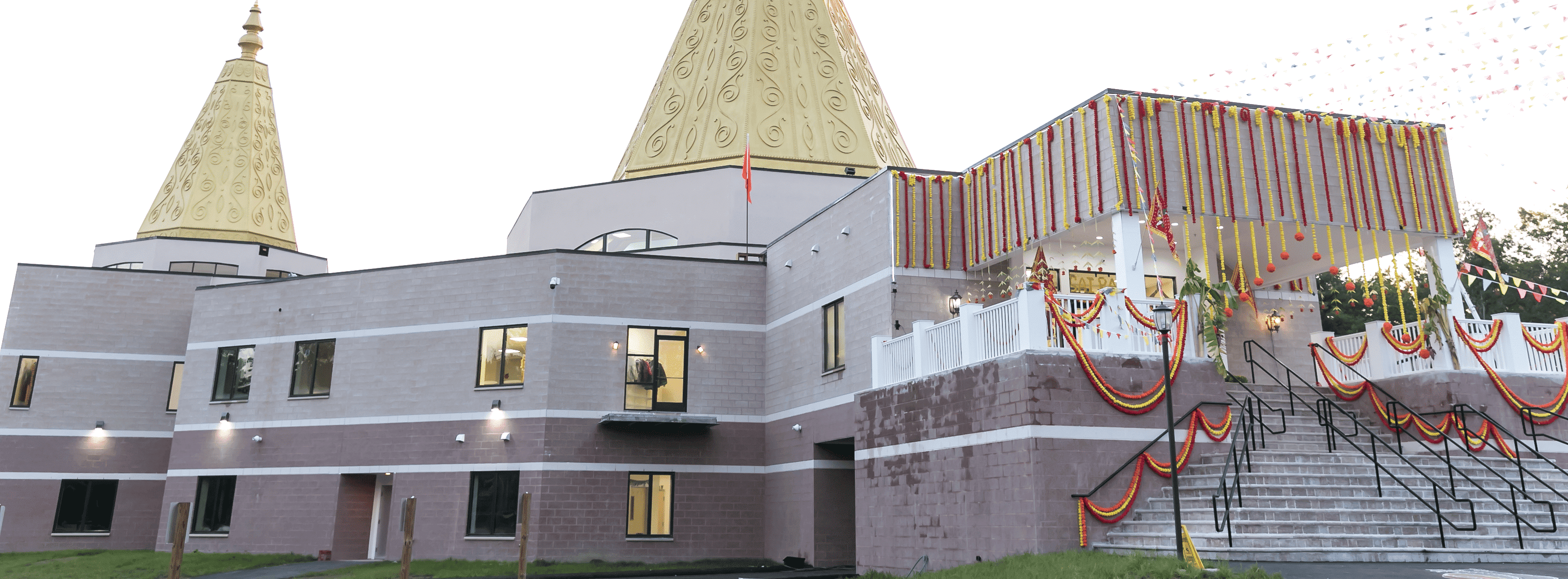
Every alternate month, and especially during the Karthika month, NESSP conducts a Samuhik Satyanarayana Vrat, since January 2017, where all pooja materials and Prasad are supplied by the temple. We only request that you signup as early as possible using the link provided, to help with our planning.
News
COVID Guidelines
In order to prevent person to person spread of COVID-19 and for the safety of devotees, priest and volunteers and to be compliant with State of Massachusetts guidelines. Your co-operation, understanding and support are highly appreciated to follow these policies.
Devotees must wear masks. No devotees will be allowed into the temple without mask without any exceptions.